

Federal Reserve set to hold interest rates steady, yet a hike can’t be ruled out
- The US Federal Reserve is seen leaving the policy rate unchanged for the fifth consecutive meeting in July.
- CME FedWatch Tool shows there is a considerable chance for an unexpected rate hike.
- Fed Chair Kevin Warsh’s comments could drive the US Dollar’s valuation.
The United States (US) Federal Reserve (Fed) announces its interest rate decision on Wednesday, another pivotal meeting for markets to gauge the stance of policymakers as they assess how rising crude Oil prices could impact the inflation outlook.
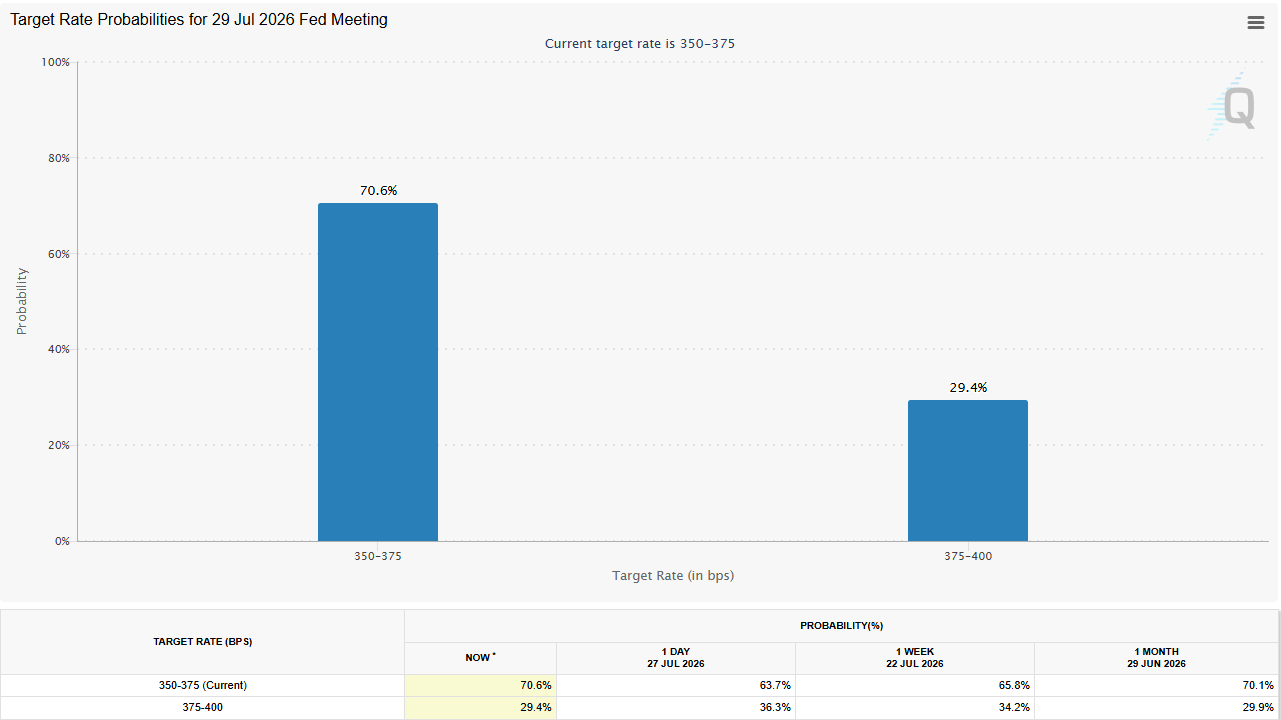
Markets widely expect the Federal Open Market Committee (FOMC) to keep interest rates unchanged in the range of 3.5%-3.75% for the fifth consecutive meeting in July.
However, this decision is not fully priced in, with the CME FedWatch Tool pointing to a nearly 30% probability of a 25 basis points (bps) interest rate hike, compared to just 15% a week ago.
After falling about 35% from May to the end of June, crude Oil prices turned north again in July. With the United States (US) and Iran exchanging strikes for nearly two consecutive weeks, the naval activity in the Strait of Hormuz came to a halt. As a result, the barrel of West Texas Intermediate (WTI) climbed above $90 from $67 at the beginning of July. Although news of the US and Iran pausing strikes helped WTI correct lower, it’s still up nearly 20% this month.
Fed hike odds rebound as oil-driven inflation worries resurface
Strategists at OCBC note that the perceived risk of near-term Fed tightening has shifted meaningfully recently. They point out that the probability of a July Fed rate hike “fell to just 10% following benign US inflation data but has since rebounded to 35% as higher oil prices reignited inflation concerns.” In their view, “a hold accompanied by hawkish guidance would likely push expected rate hikes further out the curve without materially altering the roughly 55bp of cumulative tightening priced in through mid-2027.”
However, OCBC cautions that “a decision to leave rates unchanged with little explanation could be interpreted as dovish and create confusion about the Fed's reaction function.”
When will the Fed announce its interest rate decision and how could it affect EUR/USD?
The Fed is scheduled to announce its interest rate decision and publish the monetary policy statement at 18:00 GMT. This will be followed by Fed Chair Kevin Warsh’s press conference starting at 18:30 GMT.
If the Fed announces a 25 bps rate hike, that would be seen as a hawkish surprise and boost the USD, causing EUR/USD to turn south. If the US central bank decides to hold rates steady, an important factor will be the potential number of dissents on the hawkish side.
US Dollar outlook hinges on Fed, and a surprise is on the cards
Analysts at MUFG observe that the recent pullback in Oil has eased some of the urgency around further tightening, noting that “in the near-term, the correction lower in energy prices will dampen rate hike expectations for central banks ahead of the Fed’s, BoE’s and BoJ’s latest policy meeting this week.” Against that backdrop, they reiterate that “we have been assuming that the Fed would leave rates on hold this week but one can’t completely rule out the possibility of a rate hike.”
MUFG adds that any policy surprise could have swift currency implications: “If the Fed delivers a hawkish surprise and hikes rates this week it would give the US dollar renewed upward momentum.”
In case the Fed leaves the policy rate unchanged as anticipated and refrains from making a significant change to the policy statement, which would be in line with Fed Chair Warsh’s insistence of avoiding forward guidance, the immediate market reaction is likely to remain muted. In this scenario, investors will scrutinize comments from Warsh in the press conference.
During his congressional testimony earlier this month, Warsh adopted a neutral tone with a score of 5.4/10 on the FXS Speechtracker. By calling recent inflation data an “imperfect gauge” and stressing that whether AI proves inflationary is “up to the Fed,” the remarks framed technology-driven price shifts as manageable one-offs rather than a persistent inflation threat, while acknowledging disruptive transition risks. If Warsh downplays the impact of the recent increase in Oil prices on inflation and reiterates the favorable growth outlook, markets could see that as a dovish sign and cause the USD to lose interest. Conversely, EUR/USD could turn south in case Warsh makes it clear that they will need to take action soon to tame inflation, even if the pair has an initial bullish reaction to a policy hold.
Eren Sengezer, European Session Lead Analyst at FXStreet, provides a short-term technical outlook for EUR/USD:
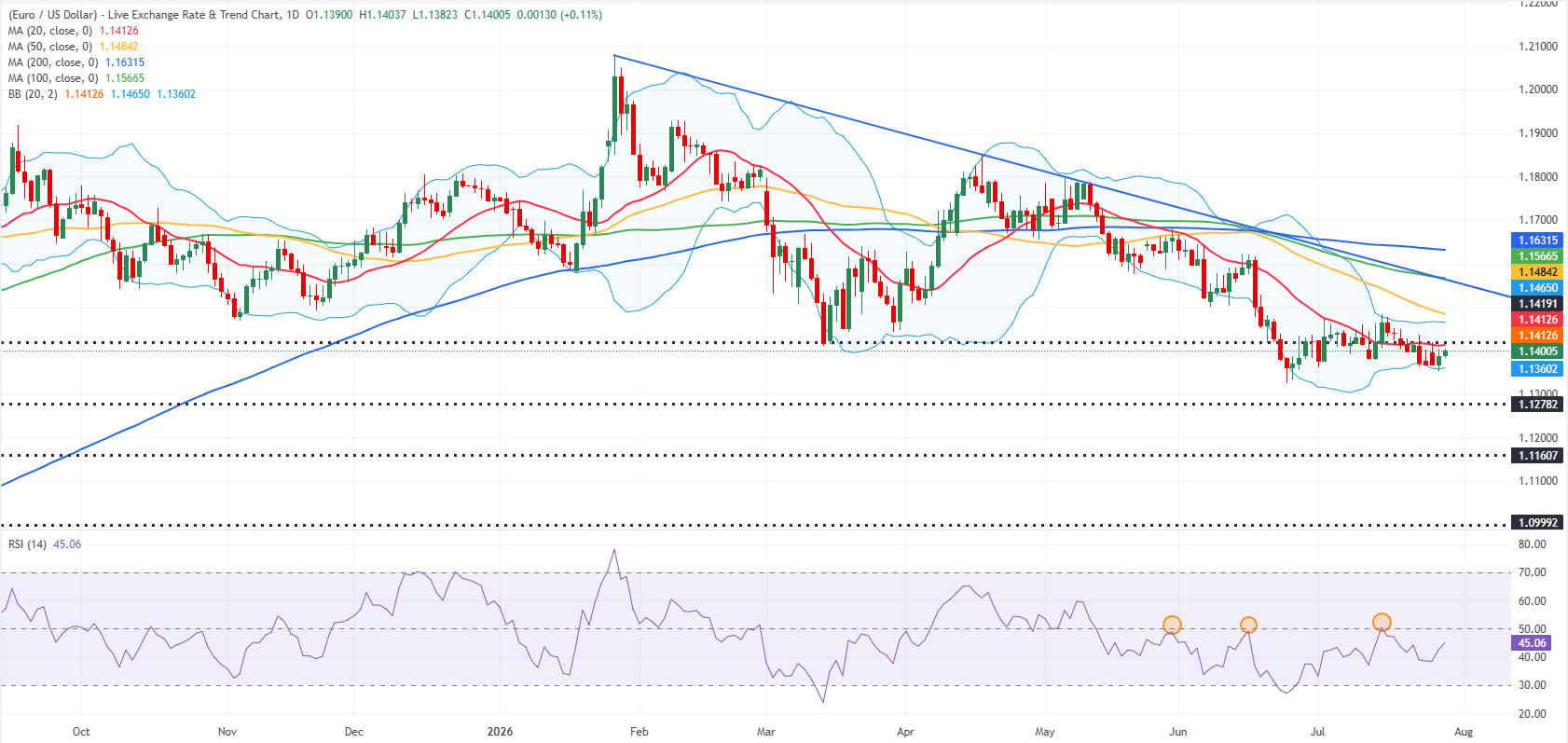
“EUR/USD has been fluctuating in a relatively tight range since the beginning of the month, but there are no signs of a bullish reversal. The Relative Strength Index (RSI) indicator on the day chart failed to clear the 50 threshold three times since early July and the descending trend line drawn from late-January stays intact.”
“On the downside, 1.1280 (static level) aligns as the next key support ahead of 1.1160 (static level) and 1.1000 (psychological level, static level). Looking north, the first resistance area could be spotted at 1.1460-1.1490 (50-day Simple Moving Average (SMA), upper arm of the Bollinger Band) before 1.1570 (100-day SMA, descending trend line) and 1.1635 (200-day SMA).
Fed FAQs
Monetary policy in the US is shaped by the Federal Reserve (Fed). The Fed has two mandates: to achieve price stability and foster full employment. Its primary tool to achieve these goals is by adjusting interest rates. When prices are rising too quickly and inflation is above the Fed’s 2% target, it raises interest rates, increasing borrowing costs throughout the economy. This results in a stronger US Dollar (USD) as it makes the US a more attractive place for international investors to park their money. When inflation falls below 2% or the Unemployment Rate is too high, the Fed may lower interest rates to encourage borrowing, which weighs on the Greenback.
The Federal Reserve (Fed) holds eight policy meetings a year, where the Federal Open Market Committee (FOMC) assesses economic conditions and makes monetary policy decisions. The FOMC is attended by twelve Fed officials – the seven members of the Board of Governors, the president of the Federal Reserve Bank of New York, and four of the remaining eleven regional Reserve Bank presidents, who serve one-year terms on a rotating basis.
In extreme situations, the Federal Reserve may resort to a policy named Quantitative Easing (QE). QE is the process by which the Fed substantially increases the flow of credit in a stuck financial system. It is a non-standard policy measure used during crises or when inflation is extremely low. It was the Fed’s weapon of choice during the Great Financial Crisis in 2008. It involves the Fed printing more Dollars and using them to buy high grade bonds from financial institutions. QE usually weakens the US Dollar.
Quantitative tightening (QT) is the reverse process of QE, whereby the Federal Reserve stops buying bonds from financial institutions and does not reinvest the principal from the bonds it holds maturing, to purchase new bonds. It is usually positive for the value of the US Dollar.













