

Trading
Explore a wide range of markets with competitive pricing, deep liquidity, and advanced trading tools.
Learn More 
Platform
Trade seamlessly with TMGM's powerful platform, built for speed, precision, and a superior trading experience.
Learn More Trading Platform
Academy
Learn the fundamentals of trading with beginner-friendly resources, including guides, webinars, and market insights.
Learn More News & Analysis
Get real-time market updates and expert analysis to stay ahead of trading opportunities
Learn More News & Analysis
About
Learn what sets TMGM apart — our global presence, regulatory strength, and commitment to innovation in trading.
Learn More Why Choose TMGM
Sponsorship
The Japanese Yen firms on a BoJ speech about AI and gives it all back
- USD/JPY round-trips a dip toward 157.50 on a BoJ speech about AI.
- BoJ Governor Ueda speaks Tuesday at 06:35 GMT, first since the September hike.
- August wages due Tuesday at 23:30 GMT, forecast at 3.7% YoY from 4.7%.
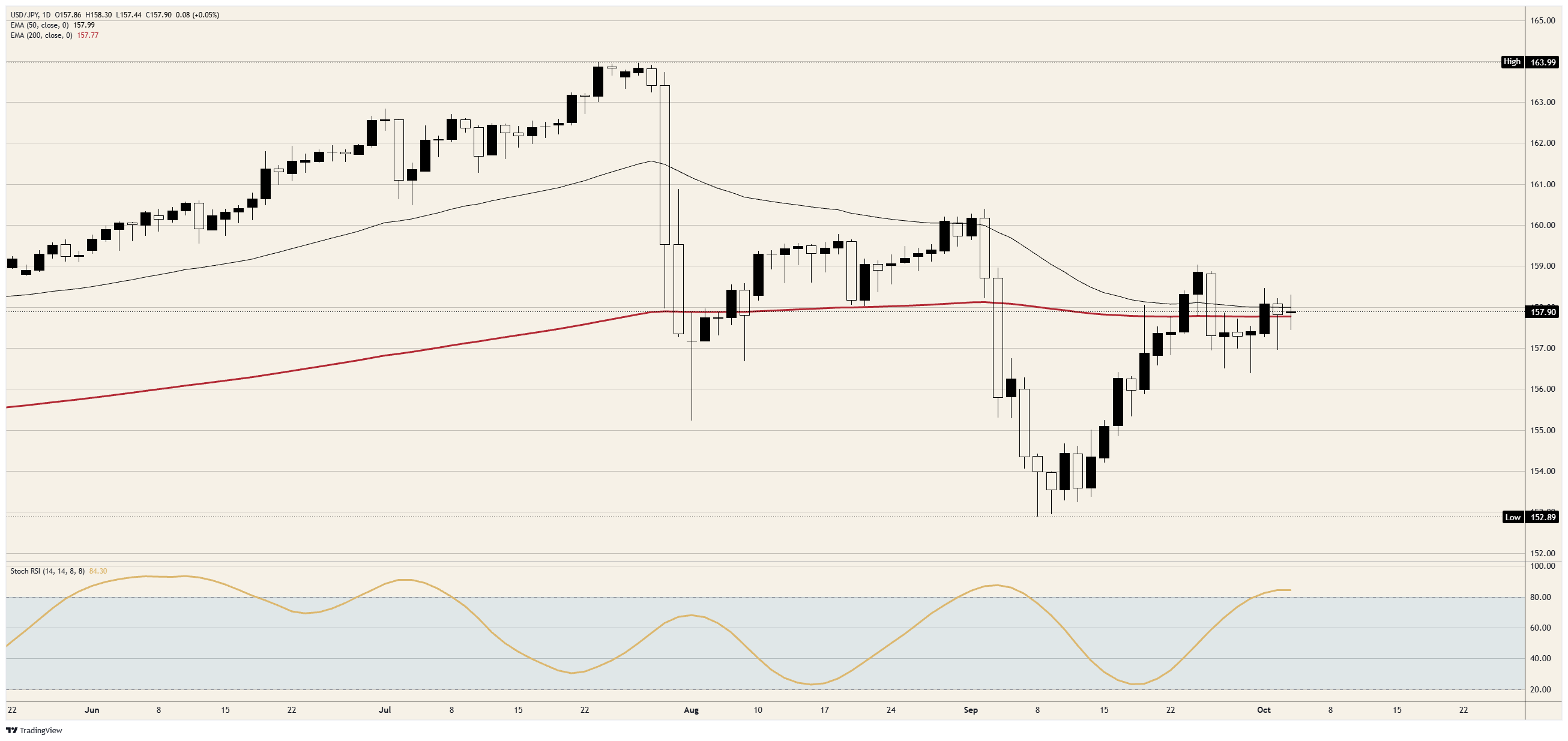
Bank of Japan (BoJ) Governor Ueda speaks on Tuesday at 06:35 GMT, and his first major remarks since the September 18 hike to 1.25% are the next test of October hike bets. Traders give a second hike on October 30 about a one-in-four chance. USD/JPY has crossed 158.00 in both directions in each of the last three sessions and trades just under it.

BoJ Deputy Governor Uchida said on Monday that artificial intelligence (AI) is a large positive demand shock pushing up activity and prices. USD/JPY dipped toward 157.50 around the remarks and was back above 158.00 well before the US data. He also said AI has made financial conditions more accommodative on balance, less than three weeks after the BoJ raised rates to tighten them.
A hike every three months points to December, not October
The BoJ raised its rate in June and again in September, and traders read the three-month gap as its pace. Governor Ueda said after the September hike that the BoJ's focus has moved from lifting inflation toward 2% to stopping it from overshooting. Stopping an overshoot before it happens would mean hiking in October, not waiting for December.
Wage growth is forecast to slow by a fifth in a month
Japan's August labour cash earnings are due on Tuesday at 23:30 GMT, forecast to rise 3.7% YoY after 4.7% in July. A slowdown that size would make an October hike harder to argue for. Governor Ueda speaks before the figures are out, so whatever he says about October comes without them.
The Fed's September minutes follow on Wednesday at 18:00 GMT. The Fed decides on October 28, two days before the BoJ, so the US half of the rate gap gets the first move.
The Yen's range into Governor Ueda
Resistance: The last three sessions have all peaked short of 158.50, the level the October 1 rally stopped under. 159.00, the September 24 high, is the next cap.
Support: Monday's low, just under 157.50, is the highest of the last four sessions. Friday's low, just under 157.00, marks where the payrolls dip ended.
Bias: Buyers keep the edge while 157.50 holds on a closing basis, aiming at 158.50 and then 159.00. The daily Stochastic Relative Strength Index (Stoch RSI) is near 84 and flattening above 80, so a firm-sounding Governor Ueda could pull the pair back to 157.50 without breaking the call. A daily close below 157.00 ends it.
USD/JPY daily chart
Japanese Yen FAQs
The Japanese Yen (JPY) is one of the world’s most traded currencies. Its value is broadly determined by the performance of the Japanese economy, but more specifically by the Bank of Japan’s policy, the differential between Japanese and US bond yields, or risk sentiment among traders, among other factors.
One of the Bank of Japan’s mandates is currency control, so its moves are key for the Yen. The BoJ has directly intervened in currency markets sometimes, generally to lower the value of the Yen, although it refrains from doing it often due to political concerns of its main trading partners. The BoJ ultra-loose monetary policy between 2013 and 2024 caused the Yen to depreciate against its main currency peers due to an increasing policy divergence between the Bank of Japan and other main central banks. More recently, the gradually unwinding of this ultra-loose policy has given some support to the Yen.
Over the last decade, the BoJ’s stance of sticking to ultra-loose monetary policy has led to a widening policy divergence with other central banks, particularly with the US Federal Reserve. This supported a widening of the differential between the 10-year US and Japanese bonds, which favored the US Dollar against the Japanese Yen. The BoJ decision in 2024 to gradually abandon the ultra-loose policy, coupled with interest-rate cuts in other major central banks, is narrowing this differential.
The Japanese Yen is often seen as a safe-haven investment. This means that in times of market stress, investors are more likely to put their money in the Japanese currency due to its supposed reliability and stability. Turbulent times are likely to strengthen the Yen’s value against other currencies seen as more risky to invest in.
Top Articles
1The Japanese Yen firms on a BoJ speech about AI and gives it all back2Gold holds steady below $4,150 amid elevated US yields 3Australian Dollar defies rising yields as AUD/USD closes in on 0.704The New Zealand Dollar holds near its lows while business confidence jumps5US Treasury yields scale multi-year highs as inflation fears return6Ethereum Price Forecast: BitMine scoops extra ETH tokens following Q3 outperformance7The Euro breaks to a fresh low, then bounces, as Spain calls a snap vote8The Pound flatlines as Treasury yields climb to another high9Mexican Peso builds winning streak as USD/MXN drifts toward 18.00
LIVE QUOTES


Get Started!
Sign up and access the Global Markets in less than 3 minutes

Connect With Us












The information provided on this website is of a general nature only and does not constitute personal financial advice. Before acting on any information on this website, you should consider the suitability of the information in relation to your objectives, financial situation and needs. Investing in CFDs and FX Margin Contracts carries significant risks and is not suitable for all investors. You may lose more than your initial deposit. You do not own, or have, any interest in the underlying asset. We recommend that you seek independent advice and ensure you fully understand the risks involved before trading. It is important that you read and consider the disclosure document before you acquire any product listed on the website. The information and advertisements offered on this website are not intended for use by any person in any country or jurisdiction where such use would be contrary to local laws and regulations. The Products and Services offered on this website are not intended for residents of the United States, Malaysia and Thailand.
TMGM is authorized and regulated in various jurisdictions.
Trademax Australia Limited, trading as TMGM, is regulated by the Australian Securities and Investments Commission (ASIC), AFSL no. 436416 and is located at Level 28, One International Tower, 100 Barangaroo Avenue, 2000 Sydney, NSW Australia.
Email: [email protected]
Trademax Global Limited, trading as TMGM, is authorized and regulated by the Vanuatu Financial Services Commission (VFSC), registration number 40356 and registered at 1276, Kumul Highway, Port Vila, Vanuatu, Republic of Vanuatu.
Email: [email protected]
Trademax Global Markets (SE) Limited, trading as TMGM, is authorized and regulated by the Financial Services Authority (FSA) of Seychelles, with license number SD224. The company is registered at Office No 13, Providence Estate ABIS Centre, Mahe, Seychelles.
Email: [email protected]
Trademax Global Markets (International) Pty Ltd, trading as TMGM, is authorized and regulated by the Financial Services Commission, Mauritius (FSC) with license no. GB22201012, and registered at 33, Edith Cavell Street C/o IQ EQ Fund Services (Mauritius) Ltd Port Louis, 11324 Mauritius.
Email: [email protected]
Copyright © TMGM. All rights reserved