US Dollar Index Price Forecast: Exposes to 99.00 on Double Top breakdown
By Sagar Dua
Updated: 31 Jul 2026


POPULAR ARTICLES

The US Dollar (USD) attempts to snap its three-day losing streak on Friday. In European trade, the US Dollar Index (DXY), which tracks the Greenback’s value against six major currencies, trades 0.27% higher to near 100.23. The DXY attracts bids after posting a fresh six-week low at 99.85.
- The US Dollar Index regains ground after a three-day losing spree.
- Investors doubt the Fed will hold to its commitment to bringing inflation down.
- A Double Top pattern breakdown backs further downside in the US Dollar Index.
The US Dollar (USD) attempts to snap its three-day losing streak on Friday. In European trade, the US Dollar Index (DXY), which tracks the Greenback’s value against six major currencies, trades 0.27% higher to near 100.23. The DXY attracts bids after posting a fresh six-week low at 99.85.
In the last two trading days, the US Dollar fell sharply as financial markets worry that the Federal Reserve (Fed) won't hike interest rates despite inflation remaining well above the central bank’s 2% target.
Markets read FOMC tone as softer as Fed seen outsourcing tightening
Analysts at ING observe that “last night's FOMC press conference was a little confusing,” but stress that the market reaction was clear: investors concluded “the Fed was not going to be as tough on fighting inflation as initially thought and might try to wriggle through this period of high inflation without hiking.” ING adds that “Chair Kevin Warsh's celebration of higher real yields and the more ‘direct’ message from the markets was taken as a view that the Fed had outsourced monetary tightening to the markets, reducing the need for hikes,” reinforcing the perception that policymakers may lean more heavily on market-driven tightening rather than additional policy rate increases.
On Wednesday, the Fed left interest rates unchanged in the range of 3.50%-3.75%, as expected, and policymakers expressed concerns regarding upside inflation risks. Fed Chair Kevin Warsh said in the press conference that the committee is committed to bringing inflation down and won’t hesitate to act if necessary.
Investors also expect that United States (US) political pressure won't let the Fed raise interest rates. Before the policy announcement, US President Donald Trump explicitly told Fed Chairman Warsh, not in person, to lower interest rates, adding that there was a good inflation report recently, costs were falling rapidly, and that prices should drop significantly once the Gulf War ends.
US Dollar Index technical analysis
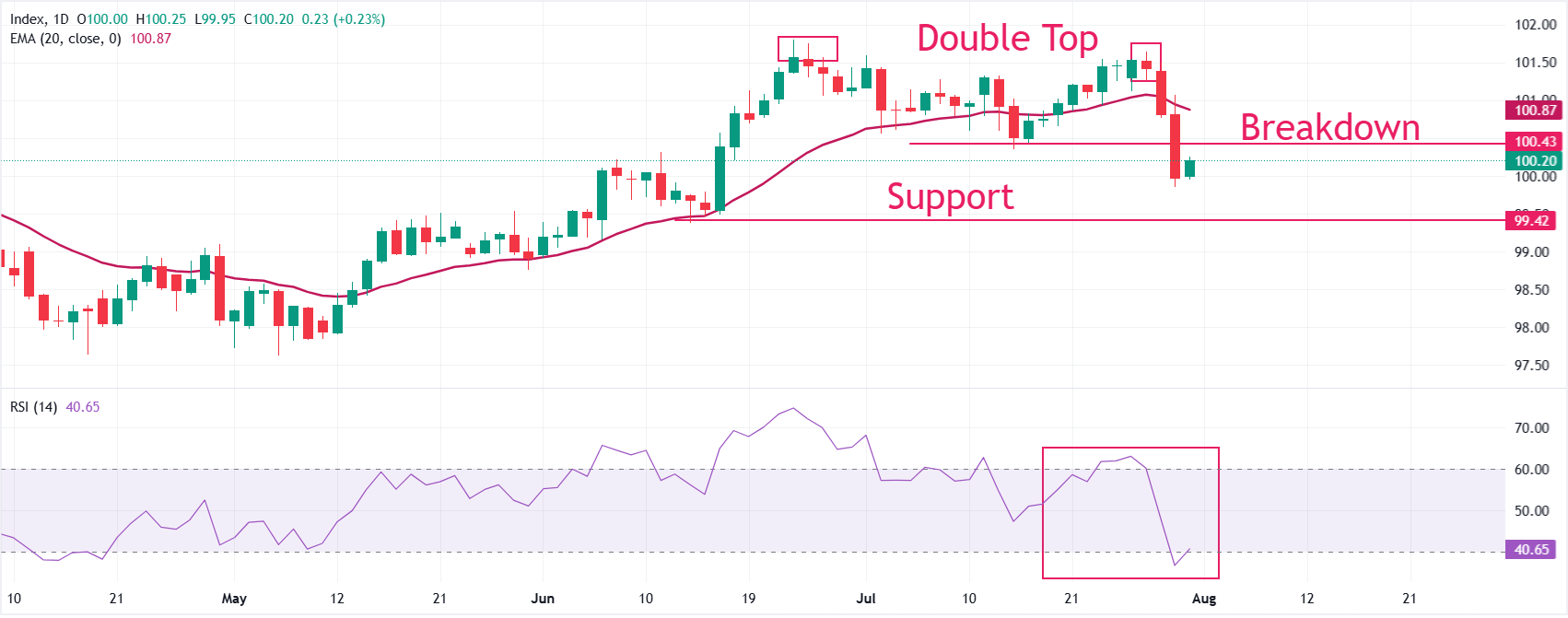
Bias: The Dollar Index spot trades higher at around 100.20, but is maintaining a bearish near-term tone as it holds below the 20-day exponential moving average (EMA) at 100.87. The breakdown of the Double Top formation near 100.40 backs the emergence of bears on the horizon.
Momentum: The index has retreated from recent highs and remains capped by this short-term trend indicator, while the Relative Strength Index (RSI) around 41 suggests fading downside momentum but not yet a decisive recovery.
Resistance: On the topside, the July 15 low at 100.35 is the immediate resistance that bulls would need to reclaim to ease the current bearish pressure and return towards the 20-day EMA at 100.87.
Support: On the downside, the pair is expected to extend the decline towards the June 15 low at 99.38, followed by 99.00.
(The technical analysis of this story was written with the help of an AI tool. Know more.)
US Dollar FAQs
The US Dollar (USD) is the official currency of the United States of America, and the ‘de facto’ currency of a significant number of other countries where it is found in circulation alongside local notes. It is the most heavily traded currency in the world, accounting for over 88% of all global foreign exchange turnover, or an average of $6.6 trillion in transactions per day, according to data from 2022. Following the second world war, the USD took over from the British Pound as the world’s reserve currency. For most of its history, the US Dollar was backed by Gold, until the Bretton Woods Agreement in 1971 when the Gold Standard went away.
The most important single factor impacting on the value of the US Dollar is monetary policy, which is shaped by the Federal Reserve (Fed). The Fed has two mandates: to achieve price stability (control inflation) and foster full employment. Its primary tool to achieve these two goals is by adjusting interest rates. When prices are rising too quickly and inflation is above the Fed’s 2% target, the Fed will raise rates, which helps the USD value. When inflation falls below 2% or the Unemployment Rate is too high, the Fed may lower interest rates, which weighs on the Greenback.
In extreme situations, the Federal Reserve can also print more Dollars and enact quantitative easing (QE). QE is the process by which the Fed substantially increases the flow of credit in a stuck financial system. It is a non-standard policy measure used when credit has dried up because banks will not lend to each other (out of the fear of counterparty default). It is a last resort when simply lowering interest rates is unlikely to achieve the necessary result. It was the Fed’s weapon of choice to combat the credit crunch that occurred during the Great Financial Crisis in 2008. It involves the Fed printing more Dollars and using them to buy US government bonds predominantly from financial institutions. QE usually leads to a weaker US Dollar.
Quantitative tightening (QT) is the reverse process whereby the Federal Reserve stops buying bonds from financial institutions and does not reinvest the principal from the bonds it holds maturing in new purchases. It is usually positive for the US Dollar.

More than a million users rely on FXStreet for real-time market data, charting tools, expert insights, and forex news. Its comprehensive economic calendar and educational webinars help traders stay informed and make calculated decisions. FXStreet is supported by a team of about 60 professionals, split between the Barcelona headquarters and various global regions.
Read More