The Australian Dollar stops trading commodities and starts trading one number
By Joshua Gibson
Updated: 27 Jul 2026


POPULAR ARTICLES

The Australian Dollar trades just beneath 0.7000 on Monday, up around 0.1%, having covered less than 30 pips between its session high and its session low. For the better part of a fortnight the market has tried to make something of the 0.7000 area and given up each time.
- AUD/USD trades just beneath 0.7000 inside a session range of less than 30 pips, still capped by a 50-day moving average that has sat above spot since the first week of June.
- Crude Oil fell almost 9% and Iron Ore remains beneath $100 a tonne, and Australia's currency is higher on the day regardless.
- June inflation lands Wednesday at 01:30 GMT with the quarterly tables attached, roughly sixteen hours before the Federal Reserve decision.
The Australian Dollar trades just beneath 0.7000 on Monday, up around 0.1%, having covered less than 30 pips between its session high and its session low. For the better part of a fortnight the market has tried to make something of the 0.7000 area and given up each time. What makes the stillness worth explaining is everything that happened around it.
A commodity currency with no commodity story
Monday delivered a genuinely large move in the things Australia sells. Crude Oil fell close to 9% on the stand-down between Washington and Tehran, dragging the wider energy complex with it and taking a direct bite out of the liquefied natural gas and coal earnings that sit alongside the mining book. Iron Ore, the country's largest export, has been stuck beneath $100 a tonne since late June.
Chinese steel output has been running roughly 5% to 6% below year-ago levels through the middle of the year, with mill inventories building rather than clearing. None of that showed up in the exchange rate. The Australian Dollar is not currently being traded as a claim on Australian production. It is being traded as a proxy for global risk appetite, and Monday's peace bid was risk-positive enough to cover the terms-of-trade damage.
One number, and it is mostly in the price
What is left is the interest rate story, and it narrows to Wednesday. The Reserve Bank of Australia (RBA) has taken the cash rate to 4.35% across three increases this year and left further tightening explicitly available at the June hold. Consensus on the June inflation report looks for 0.2% MoM on the headline against a 0.7% fall previously, with the trimmed mean holding at 0.4% MoM and the annual pace last printed at 4% and 3.6% respectively.
The problem for anyone hoping to buy this currency on a hot number is that the number is already spoken for. Swaps carry a further quarter-point increase inside six months, a majority of surveyed economists expect at least one more move this year, and most of those who do put it at the August meeting. A print that confirms all of that pays the Australian Dollar very little. A print that undercuts it removes the only bid the currency has. That asymmetry is the whole trade.
There is a second reason the peace trade helps here rather than hurting. Australia's inflation problem this year has been an imported one, and a sustained retreat in energy costs takes pressure off the same electricity and fuel components that drove the March annual rate to its highest since 2023. That cuts both ways for the currency, easing the cost-of-living squeeze while quietly weakening the case for the very hike the exchange rate depends on.
Three events in forty hours
The sequence starts Tuesday at 03:05 GMT with a scheduled speech from the RBA governor, the last official word before the data and a natural venue for tone-setting. June inflation follows Wednesday at 01:30 GMT carrying the quarterly tables, and the 11 August decision effectively hangs on it. Thursday brings building permits at 01:30 GMT, seen at -0.5% MoM after -1.1%.
The American half arrives Wednesday at 18:00 GMT, where consensus expects a fourth consecutive hold at 3.75% with no Summary of Economic Projections attached and a live minority priced for a hike. Thursday's 12:30 GMT block carries second-quarter growth at 2.1%, core Personal Consumption Expenditures at 0.2% MoM and 3.3% YoY, and jobless claims seen rebounding to 204K from 187K. Friday then closes the loop for this pair with Australian producer prices and both Chinese official Purchasing Managers Index readings, manufacturing and non-manufacturing, each expected to land exactly on the 50 line that separates expansion from contraction.
June employment gave the hawks a headline to work with, 76.3K jobs against a 15K consensus, though the statistics agency flagged a data quality adjustment in two states that argues for treating the size of the beat carefully. July business surveys had manufacturing and services both in expansion. The domestic picture is solid enough to justify a hike and nowhere near hot enough to force one, which is precisely why the currency has gone nowhere.
Australian Dollar levels
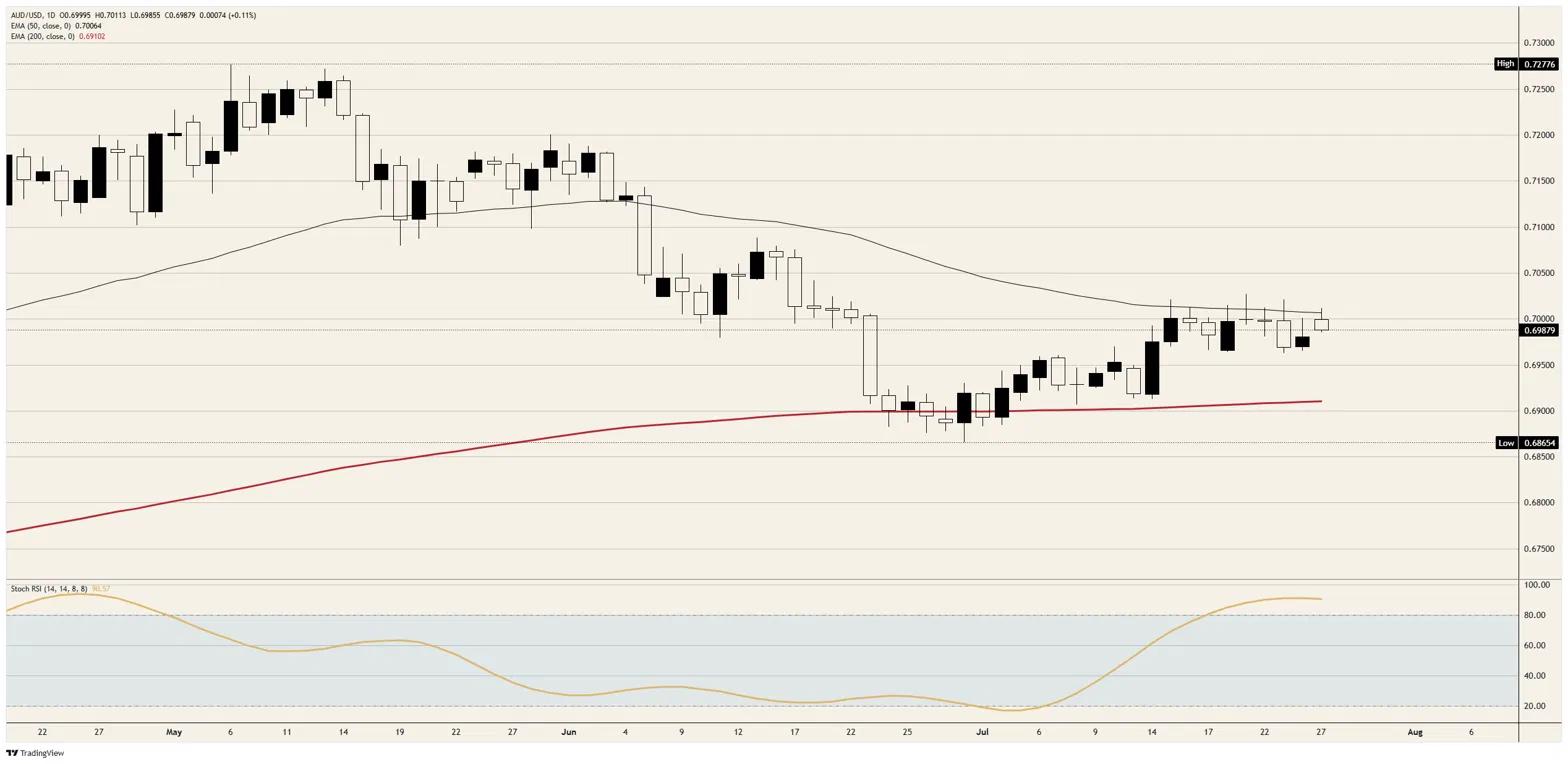
Upside: The declining 50-day Exponential Moving Average (EMA) sits just above 0.7000 and has capped every attempt since the first week of June, with 0.7050 the level that would confirm a genuine break.
Downside: 0.6950 is the first shelf, and beneath it the rising 200-day EMA near 0.6900 is the line that has underpinned the pair since late June.
Bias: Bearish. A daily Stochastic Relative Strength Index reading above 90 while price sits under a falling 50-day average is momentum spent at the top of a range rather than the start of a trend, so fade strength into 0.7050 toward 0.6950 and then 0.6900, and abandon the view on a daily close above 0.7050.
AUD/USD daily chart
Australian Dollar FAQs
One of the most significant factors for the Australian Dollar (AUD) is the level of interest rates set by the Reserve Bank of Australia (RBA). Because Australia is a resource-rich country another key driver is the price of its biggest export, Iron Ore. The health of the Chinese economy, its largest trading partner, is a factor, as well as inflation in Australia, its growth rate and Trade Balance. Market sentiment – whether investors are taking on more risky assets (risk-on) or seeking safe-havens (risk-off) – is also a factor, with risk-on positive for AUD.
The Reserve Bank of Australia (RBA) influences the Australian Dollar (AUD) by setting the level of interest rates that Australian banks can lend to each other. This influences the level of interest rates in the economy as a whole. The main goal of the RBA is to maintain a stable inflation rate of 2-3% by adjusting interest rates up or down. Relatively high interest rates compared to other major central banks support the AUD, and the opposite for relatively low. The RBA can also use quantitative easing and tightening to influence credit conditions, with the former AUD-negative and the latter AUD-positive.
China is Australia’s largest trading partner so the health of the Chinese economy is a major influence on the value of the Australian Dollar (AUD). When the Chinese economy is doing well it purchases more raw materials, goods and services from Australia, lifting demand for the AUD, and pushing up its value. The opposite is the case when the Chinese economy is not growing as fast as expected. Positive or negative surprises in Chinese growth data, therefore, often have a direct impact on the Australian Dollar and its pairs.
Iron Ore is Australia’s largest export, accounting for $118 billion a year according to data from 2021, with China as its primary destination. The price of Iron Ore, therefore, can be a driver of the Australian Dollar. Generally, if the price of Iron Ore rises, AUD also goes up, as aggregate demand for the currency increases. The opposite is the case if the price of Iron Ore falls. Higher Iron Ore prices also tend to result in a greater likelihood of a positive Trade Balance for Australia, which is also positive of the AUD.
The Trade Balance, which is the difference between what a country earns from its exports versus what it pays for its imports, is another factor that can influence the value of the Australian Dollar. If Australia produces highly sought after exports, then its currency will gain in value purely from the surplus demand created from foreign buyers seeking to purchase its exports versus what it spends to purchase imports. Therefore, a positive net Trade Balance strengthens the AUD, with the opposite effect if the Trade Balance is negative.

More than a million users rely on FXStreet for real-time market data, charting tools, expert insights, and forex news. Its comprehensive economic calendar and educational webinars help traders stay informed and make calculated decisions. FXStreet is supported by a team of about 60 professionals, split between the Barcelona headquarters and various global regions.
Read More